
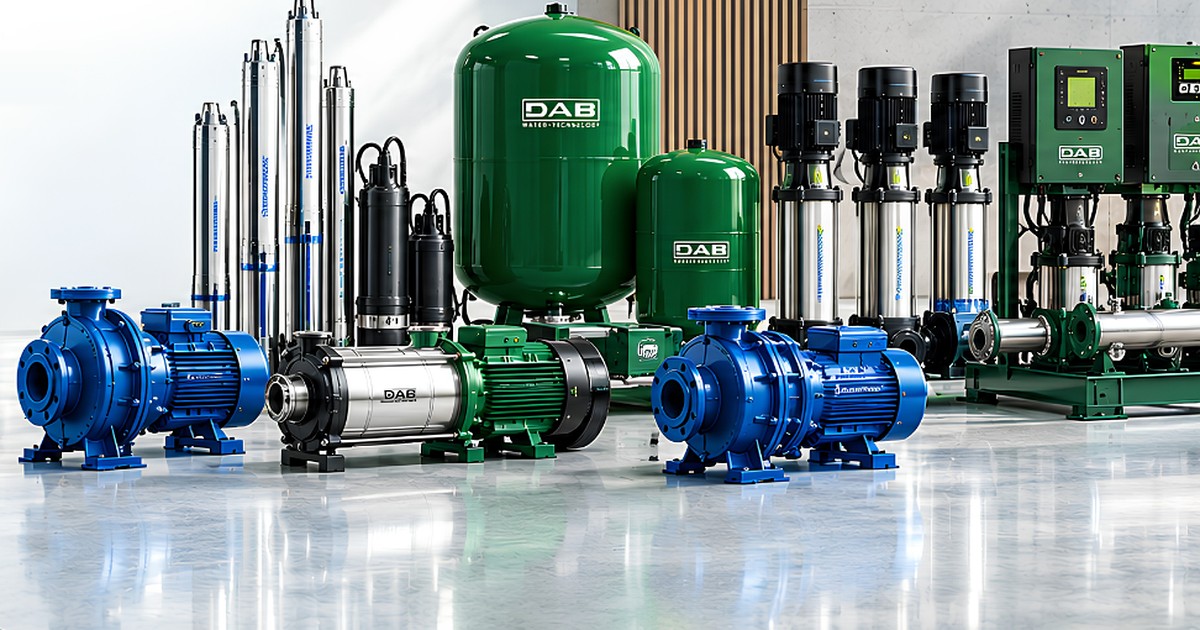
Quick answer: The right water pump for home in Pakistan depends on four things: where your water comes from (underground tank, bore or mains), the total head (how high and how far it must push), the flow you need, and your power supply (single phase, with voltage swings). For filling an overhead tank from an underground tank, a surface centrifugal pump is usually enough. For weak pressure at taps and showers, you need a booster pump (often called a pressure motor). For a bore, you need a submersible pump. Choose by flow and head, not by HP alone.
Start with your problem, not the pump
Most people search “best water motor for home” and compare horsepower. That is the wrong starting point. Two homes with the same 1 HP motor can need completely different pumps. Start with what is actually going wrong in your house:
| Your situation | What you likely need |
|---|---|
| Water is in an underground tank and must reach the roof tank | Surface centrifugal pump (water motor) |
| Taps and showers have weak pressure, even with a full tank | Booster pump (pressure motor), preferably with a pressure tank or inverter control |
| Water comes from a bore or deep well | Submersible (borehole) pump |
| Shallow well or tank close to the pump, small demand | Small surface or jet-type pump |
| Frequent load-shedding or very high electricity bills | Smart/inverter pump, or a solar-ready pump |
Types of home water pumps in Pakistan
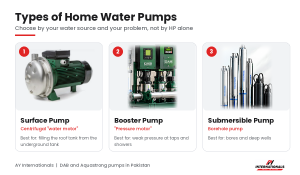
1. Surface centrifugal pumps (the usual “water motor”)
These sit on the ground and push water through pipes using a spinning impeller. They are the most common choice for lifting water from an underground tank to an overhead tank. They are easy to service, but they must be primed (filled with water) before starting, and they should never run dry. If you want to understand how they work in more detail, read our guide to DAB centrifugal pumps in Pakistan.
2. Booster pumps (pressure motors)
A booster pump raises the pressure of water that is already flowing, for example from your overhead tank to the shower. It is the right answer when the tank is full but the taps still run weakly. Modern all-in-one booster sets add a pressure sensor, and some use an inverter to run only as fast as needed. DAB, for instance, offers the EsyBox family of compact all-in-one pressure sets, and Aquastrong has smart booster pumps with a quiet permanent-magnet motor and built-in protection.
3. Submersible (borehole) pumps
These go inside the bore and push water up. Use them when your water source is deep, because surface pumps can only pull water a few metres. Check the bore diameter and water level before choosing a model.
4. Smart and inverter pumps
Smart pumps adjust their speed to the demand, keep pressure steady and protect themselves against dry running or overload. They cost more upfront, but they can save electricity and are gentler on the motor, which matters when voltage fluctuates.
5. Solar pumps
Solar-ready pumps make sense where power is unreliable or bills are high, especially for bores and garden or tank filling. They need a properly sized solar array, so plan the whole system rather than just buying the pump.
How to size a water pump for your house
Sizing is simple once you know two numbers: flow and head.
Step 1: Work out the flow you need
Flow is how much water you need per minute, measured in litres per minute (L/min) or cubic metres per hour (m³/h). Count how many taps, showers and appliances may run at the same time at peak. A tap or shower typically uses roughly 6 to 12 L/min, so add up the outlets that run together. For simply filling a tank, flow matters less. A smaller pump can do it, just more slowly.
Step 2: Work out the total head you need
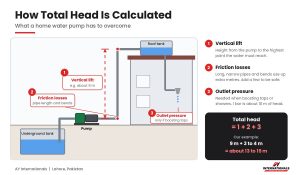
Total head is the effort the pump must make, measured in metres:
Total head = vertical lift + friction losses in the pipes + pressure needed at the outlet
- Vertical lift: the height from the pump (or water level) to the highest point, such as the roof tank inlet.
- Friction losses: longer, narrower pipes with many bends lose more. Add a few extra metres to be safe.
- Pressure at the outlet: as a rule of thumb, 1 bar is about 10 metres of head.
Worked example
A two-storey house has an underground tank, and the roof tank inlet is about 9 m above the pump. The pipe run is around 25 m with several bends. Vertical lift is 9 m, friction and fittings may add around 3 to 4 m, so aim for roughly 13 to 15 m of total head at a flow that fills your tank in a reasonable time. Then read the pump curve and pick a pump whose curve passes through that point, close to its best-efficiency range. Do not simply pick the largest motor.
Tip: HP tells you the motor’s power, not what the pump delivers. Always compare flow and head on the pump’s performance curve. A 1 HP pump with the wrong curve can perform worse than a well-matched 0.5 HP pump.
Do you need a booster pump?
Low water pressure in the house has several possible causes, and a booster pump is not always the first fix. Check these in order:
- Tank height. If the overhead tank is only a few metres above the taps, gravity pressure will always be weak. A booster pump is the real solution here.
- Pipe size and blockages. Narrow or partly blocked pipes cut flow. Larger pipes can help flow, but they do not raise pressure by themselves.
- Partly closed valves and clogged filters. Check strainers and valves first.
- Pump too small. If a pump runs but cannot keep up, its head or flow does not match your demand.
If the tank is high enough and the pipes are clear but pressure is still weak, a booster pump with a pressure tank or inverter control will give steadier pressure than a simple on/off motor.
Pakistan specific things to check before you buy
- Voltage fluctuation. Low or unstable voltage is a leading cause of burnt motors. Use a voltage protector or stabiliser, and consider a pump with built-in overload and dry-run protection.
- Single-phase supply. Most homes run on single phase (230 V). Confirm the pump’s voltage and phase before ordering.
- Heat. Pump motors run hot in summer. Place the pump in a shaded, ventilated spot and check the pump’s maximum ambient temperature.
- Water quality. Sand, silt and hard water wear impellers and seals faster. If your water is dirty, use a strainer or filter and pick materials such as stainless steel where suitable.
- Power cuts. If you run a UPS, generator or solar, make sure the pump is compatible with it, especially inverter pumps.
- After-sales support. Spare parts, repair service and a clear warranty matter more than a slightly lower price.
Common mistakes people make
- Buying by HP alone and ignoring flow and head
- Using a surface pump to lift water from a deep bore
- Installing the pump too far from the water, or with a long, leaking suction pipe
- Forgetting a foot valve and strainer on the suction line
- Running the pump dry because the tank was empty
- Skipping voltage protection
- Choosing the cheapest unbranded pump with no warranty or service
Choosing a brand and checking it is genuine
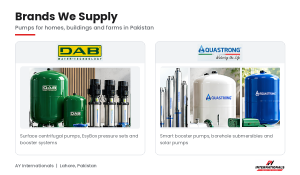
At AY Internationals we supply DAB and Aquastrong pumps in Pakistan. Both brands offer the main types a home needs: DAB covers surface centrifugal pumps and EsyBox pressure sets, and DAB also provides an online selection tool, DNA, to help match a pump to your requirements. Aquastrong covers domestic pumps, submersible borehole pumps, solar pumps and smart pumps.
You can also use DAB’s online selection tool, DNA, or read more about Aquastrong’s pump range.
Whichever brand you buy, verify these before paying:
- The exact model code on the box and nameplate matches the datasheet
- The seller can show warranty terms and after-sales support
- The pump’s voltage, phase and frequency suit your supply
- You can get spare parts (mechanical seals, capacitors, impellers) locally
Installation and maintenance basics
- Prime the pump before the first start, and never run it dry.
- Keep the suction pipe short, straight and airtight. Air leaks are the most common cause of poor performance.
- Use a foot valve and strainer on the suction side.
- Fit a non-return valve on the delivery side.
- Clean the strainer and check for leaks at the shaft seal regularly.
- Keep the pump dry, ventilated and protected from direct rain.
Not sure which pump fits your home?
Tell us your house size, tank height, water source and what problem you are facing. We will recommend a pump that fits your flow, head and power supply, instead of simply the biggest one.
Call/WhatsApp: +92 300-8482031
Browse: DAB pumps | Aquastrong pumps | Contact us
Frequently asked questions
Which water pump is best for home use in Pakistan?
It depends on your setup. A surface centrifugal pump suits filling an overhead tank from an underground tank, a booster pump suits weak pressure at taps, and a submersible pump suits a bore. Choose by flow and head, not HP alone.
How many HP water motor do I need for my house?
There is no single answer. Many houses use 0.5 to 1 HP, but the right size depends on tank height, pipe length and flow needed. Calculate total head and flow first, then compare pump curves.
What is the difference between a water motor and a booster pump?
A water motor (surface pump) moves water from one place to another, for example into a roof tank. A booster pump increases the pressure of water already in your pipes, so showers and taps flow better.
Do I need a booster pump for my house?
You need one if pressure is weak even though the tank is full and the pipes are clear, for example when the overhead tank is only slightly higher than the taps. Check tank height, pipe size and valves first.
Why is my water pressure low from the overhead tank?
Common causes are a low tank height, narrow or blocked pipes, partly closed valves and an undersized pump. Larger pipes can improve flow, but only height or a booster pump raises pressure.
Can a centrifugal pump lift water from a bore?
Not efficiently from deep bores. Surface pumps pull water up and are limited by suction lift. Bores need a submersible pump placed inside the bore.
How do I protect my water pump from voltage fluctuation?
Use a voltage protector or stabilizer, choose a pump with overload protection, and avoid running it at very low voltage. Smart or inverter pumps often include built-in protection.
How long does a home water pump last?
With correct sizing, clean water, voltage protection and regular maintenance, a good home pump can serve for many years. Dry running, voltage problems and dirty water shorten its life.
Conclusion
Choosing the right water pump for home in Pakistan comes down to your water source, total head, flow and power supply, not just the HP printed on the motor. Match the pump type to your actual problem, protect it against voltage swings and dry running, and buy from a supplier who can advise on sizing and support you after the sale.

Dua Nadeem
Dua Nadeem is a digital marketing professional with a focus on SEO and content writing. She creates research backed, search friendly content that helps businesses rank higher on Google, reach the right audience and turn visitors into customers. At AY Internationals she shares practical guides on DAB pumps, Aquastrong water systems and buying decisions in Pakistan.
All Author Posts